Here’s how I use AI as an Author
As little as possible. That is to say, every single word I write, I have written myself. I do not ask an AI to write them for me and then copy and paste them in. I don’t bring my cool ideas to a machine and let it —rather badly— write it for me. The way I see AI, any LLM, is as a really vast and quick textbook. Like any textbook, it can be wrong or outdated, and is entirely dependent on having been written by someone. This funny-looking vtuber makes some great points in her video, AI Writing is Trash, But AI “Writers” Will Never Notice. She covers all the reasons why AI writing is bad by showing us trash AI writing and then absolutely demolishing it. Funny accent included. Now, the writing being bad is one thing, but my own key problem with using AI to write for you, is the point of writing is for us to be writing. It really is as simple as: “Why would I have something else write for me?”
It isn’t just fiction writing that we see the use of AI as bad. This crosses many different fields. From the wonderful essay written by Rita Ahmadi called How should we define mathematical beauty in the AI age Rita defines beauty in mathematics as:
“A simple mathematical structure that surprises even the most experienced mathematicians and transfers a sense of vitality.”
I love the way she utilizes the word vitality to describe the human side of creation. A textbook might be able to tell us why a sentence is structured properly, but a textbook could never intentionally break a sentence to convey something special, something with vitality.
The problems with using AI
I write all of my words because I want them to be mine. This is easy to understand, but there is now significant research emerging that suggests that the use of AI will actually undermine your skills. There’s an effect called “the exoskeleton effect” which describes the process of gaining a quick boost in productivity in the moment, but once the AI is removed from the equation the user is no more skilled than they were before. If my goal is to get better at writing, then that means I need to be writing without AI assistance. People have been writing well for thousands of years. There’s no reason I shouldn’t be able to figure out how without AI.
Another, perhaps more insidious, side effect of using AI is called “agency decay.” Essentially, people’s ability to critically think is eroded away so much that instead of going for assistance on a task, they are going to AI for every facet of their life, and without AI’s input regarding whatever it is they are unable to face the task themselves. They don’t even question what the AI told them, and instead accept it without question.
In the What is Agency Decay article written by Cornelia Walther, she lays out some ways to counteract this effect, with my favorite being “acceptance”. She says:
“Acceptance involves strategically integrating AI where it provides clear value and enhances human performance”
I think a key point to focus in on is “clear value”. It is not obvious to me that AI in writing as a whole provides clear value. So then, how is it that I utilize it as an author?
How I use AI
Let’s take a look at one of my favorite newsletters, Tangle. They made a statement about their AI usage recently that really stuck with me in its simple and direct mindset.
“Outside of fact-checking and research support, though, we don’t expect to meaningfully incorporate AI into other aspects of our work.”
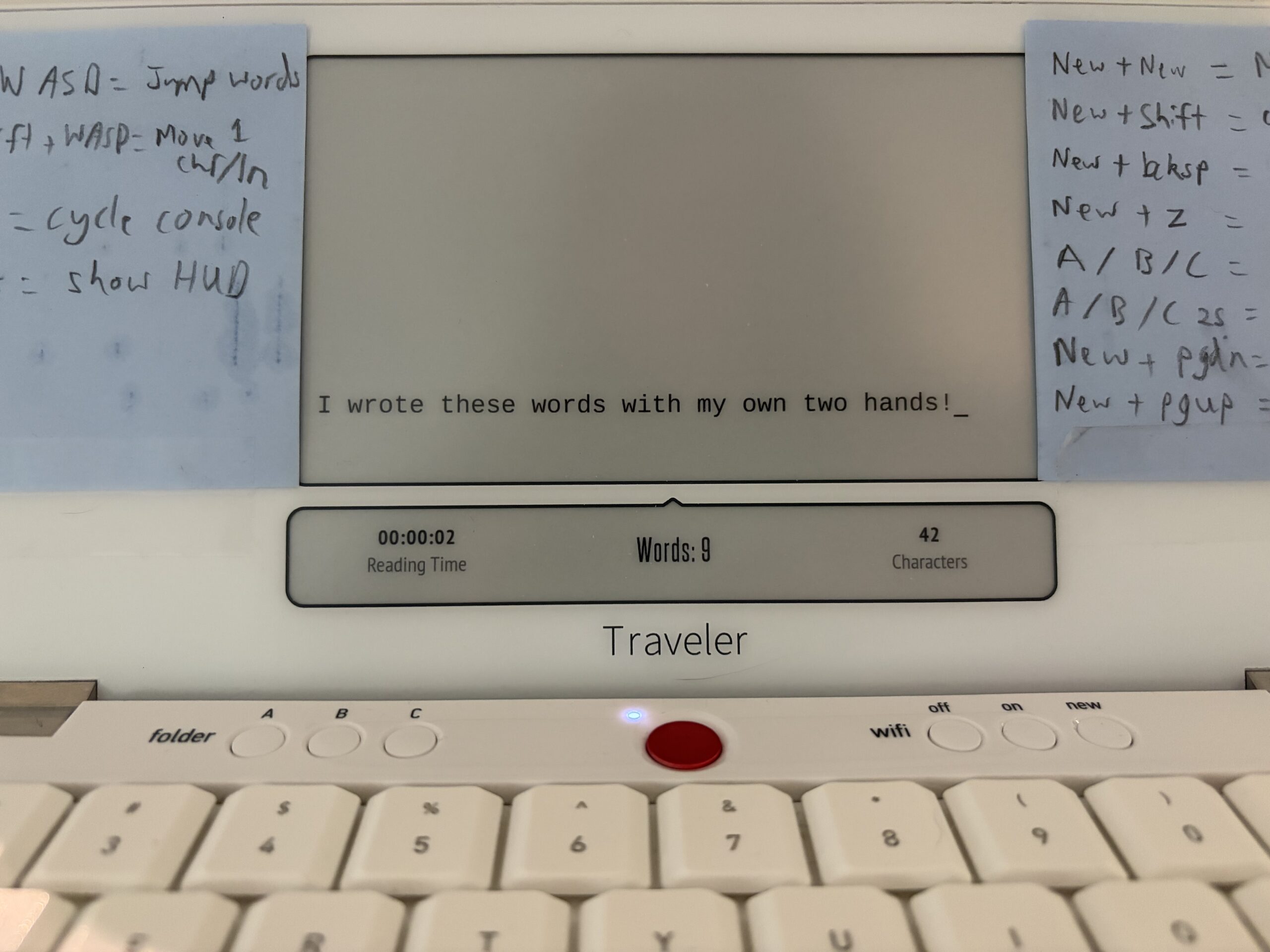
They described AI as “one of our team,” but were quick to add “it certainly cannot replace any one of our team.” While I wouldn’t consider a textbook a part of the team any more than I’d consider my Freewrite Traveler, I do agree with the addition of another tool to the arsenal. So, an incredibly reputable and factual source like Tangle utilizes AI for fact checking and research support. They clearly believe it adds value. Research and fact checking do not require vitality. It is what we do with the verified facts and research material that determines life and recognizable human qualities.
So, I use AI to assist my own research and fact checking, but I also utilize it for doing a final proofread. For many years there have been tools that do this exact thing, and I’m considering finding myself a tool built specifically for doing proofreading. I’d rather my characters gave “a wry chuckle,” instead of a “rye chuckle.” AI is good at catching that until I find a specific tool for this.
A final use is utility tasks. A good example, I copy and pasted text from the exoskeleton research paper, and when I pasted it the formatting was all wonky. Could I have gone in and line by line corrected the spacing and formatting? Of course. But AI fixed the formatting and prepared it for markdown in a matter of seconds, and considering that was for my own research purposes anyway, there’s no harm in AI speeding up my ability to extract that information.
A final word about Editing
There are a lot of arguments about AI being a useful tool in editing. Give an AI a segment of writing you have already written, give it clear commands not to rewrite, or even suggest rewrites, and have it perform like an editor that points out things that are wrong and leave it to the author to fix them.
I can see this use case, and I even heard this argument given both favorably and unfavorably on the Intentionally Blank podcast. The argument being that if you do not have access to an editor that can provide this same sort of service, this can supplement that.
I’ve experimented with this use of AI, and what I’ve found is I’m usually more inclined to simply ignore what the AI said. If I’m ignoring what it said, then that isn’t a clear indicator of value.
PS
Oh and AI images! I won’t be using them.
Dallas is based in Houston with his wife, daughter, fat orange cat, and dachshund. IT guy by day, author by night.